
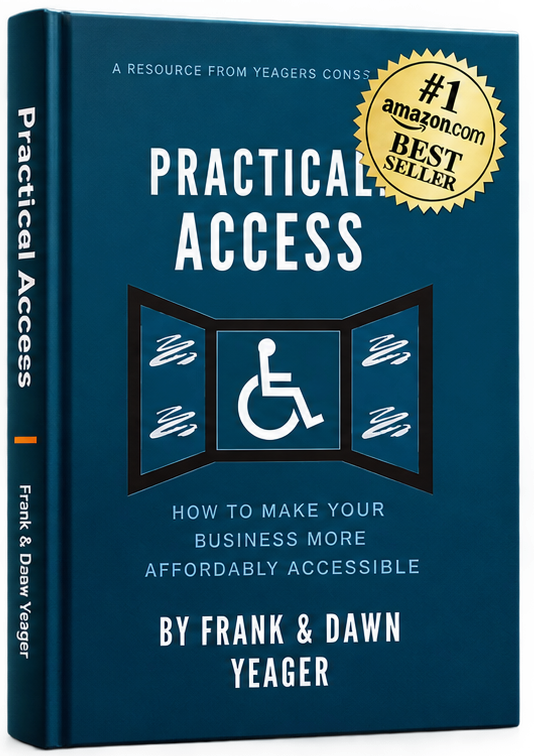
Practical Access
How to Make Your Business More Affordably Accessible
Between a fifth and a quarter of Americans have a disability.
Over sixty percent of households have at least one disabled family member.
If they can't get in, they go somewhere else.
And they don't come back.
Accessibility isn't simply a compliance exercise. It's a customer service decision, and many businesses struggle with it because nobody has shown them where the problems actually are or how to fix them in an order that makes sense.
Practical Access, by Frank and Dawn Yeager, provides a straightforward approach to identifying barriers, prioritizing improvements, and making commercial spaces more accessible without spending money unnecessarily.

Accessibility Begins at the Front Door
An accessible restroom doesn't help a customer who can't enter the building.
That's the fundamental idea behind Practical Access: work from the outside in.
Drawing on Frank's construction and accessibility experience and Dawn's decades of navigating the built environment as a wheelchair user, the book brings together the technical and human sides of accessibility.
Rather than treating every deficiency as an equally urgent construction project, the authors explain how to identify the barriers that matter most, develop a realistic budget, and implement improvements in a sequence that produces meaningful results.
What You'll Discover
Recognize the Compliance–Function Gap
Understand why meeting technical accessibility requirements doesn't always translate into a usable environment.

Make Accessibility Affordable
Explore the Disabled Access Credit, providing eligible small businesses with a credit of up to $5,000 annually, and the Architectural and Transportation Barrier Removal Deduction, allowing qualifying businesses to deduct up to $15,000 in eligible expenses annually. These incentives can be used together, subject to applicable rules.

Follow the Practical Access Methodology
Explore a five-step process for surveying a facility, developing a plan, establishing a budget, implementing improvements, and gathering feedback.

Consider Employees, Too
Discover how workplace accessibility affects recruitment, retention, productivity, and the everyday experience of employees with disabilities.

Work From the Outside In
Learn why parking, accessible routes, and entrances should be evaluated before investing in interior improvements.

Understand Legal Exposure
Discover how a written accessibility plan with a documented budget functions as a legal defense, why proactive businesses with visible plans are less attractive targets for frivolous litigation, and why the cost of doing nothing consistently exceeds the cost of getting started.

Avoid Common Mistakes
Identify improvements made in the wrong sequence, ineffective quick fixes, and misconceptions about accessibility obligations.

Prepare for Changing Expectations
Consider how technology, demographics, and customer expectations will influence commercial accessibility in the years ahead.

Who Should Read This Book?
Practical Access is written for business owners, commercial property managers, retail and hospitality operators, franchise owners, and anyone responsible for making a commercial space accessible.
It's also relevant to architects, contractors, accessibility consultants, inspectors, insurers, and risk professionals.
The book combines construction knowledge, financial considerations, and lived experience to help businesses approach accessibility as an ongoing operational priority rather than a one-time compliance project.
Accessibility Doesn't Have to Begin With a Major Renovation
It begins with understanding where the barriers are, which ones matter most, and what to do first.
Start with a plan. Work from the outside in. Make every improvement count.


